A Scoville Scale for Dangerous Questions
| July 26, 2007 | Posted by William Dembski under Just For Fun, Philosophy |
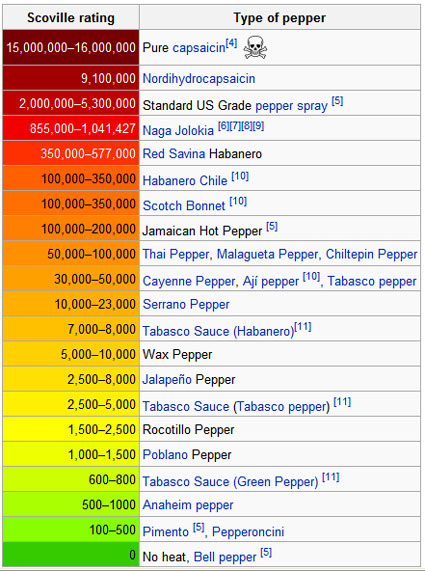
As Denyse pointed out (go here), Steven Pinker’s “dangerous questions” were really pretty mild stuff. I’d like to propose a Scoville scale for dangerous questions (based on the hotness of chili peppers). In the comments, please include what you regard as dangerous questions for materialism as well as a “hotness” measure for each question. Let me get the ball rolling:
What would happen if the general public not only disbelieved materialism (as it is, they disbelieve it now) but also decided to cease funding it out of their tax dollars? [Hotness = Serrano Pepper]
52 Responses to A Scoville Scale for Dangerous Questions
Leave a Reply
You must be logged in to post a comment.
Atom: “There is a small campfire giving off smoke in the woods. It could just be a fire. Or it could mean “Send help, the army is coming.â€Â
Right. But a computer could make the distinction soley based on its material programming. Granted, humans programmed the computer. But humans have consciousness, which is the real reason I reject materialism.
It all gets back to consciousness, IMO, otherwise, I don’t think people would be arguing over any of this. (Try to imagine unconscious entities arguing over it.) Some people seem to see this, and some don’t. And never the twain shall meet. Even Dembski and Davescot are at odds on this, even on this blog. So what more can I say?
Before anyone suspects me of being a mere troll and gives me the boot, I will say that I am basically an honest, non-religious man, who thinks consciousness is a huge clue that some other than the material universe exists. What more can I say?
mike1962: The *idea* of materialism exists in your material brain. If it didn’t, would you be able to write about it now?
I’m not sure I agree with this. I think it tends to assume what is at issue. I lean toward the notion that what exists in my material brain is a state that *represents* the ideas that I have, but that the ideas themselves are part of my incorporeal self. In other words, I think the material brain is similar to a computer in that it can have states that represent ideas, but not really have ideas of its own.
Re 33:
In short, code is inherently about pointing to something other than the matter in question that holds the significant state, and in a context of interpretation.
E.g. what does GIFT mean? [Whether glyphs or systems of binary codes makes little difference to the symbols and their meaning . . . GIFT can be in multiple paces at once and undergo multiple representations . . .]
ANS: In English, some thing usually welcome [there was once a Trojan horse (story) after all, thus " 'ware the Greeks bearing gifts . . ." . . .] but in German, something not usually welcome [save that in Pharmacology drugs are in effect poisons in small doses . . .]
And note that the issue of meaning is not anchored to the question of empirical, factual reality or observability! [The Iliad is meaningful, though doubtfully factual . . .]
GEM of TKI
Hi there, I have been working on a general theory of culture, quite an enterprise and 2009 as the 150th Aniversary of ‘Origin of the Species’ looms large in developing a theory which meets the rigours of physical and natural sciences as well as providing a telling ‘home’ for all the social disciplines. Religion has to be accounted for because sociologically it is a deep reality within almost every culture in the history of mankind.
My own position is that such a general theory of culture must neither undermines nor underline religion because it operates on a different intellectual frequency to faith. The position I take on ID is that certainly regarding culture it is a clear overextension into a realm of epistemology that may appear ‘irreducibly complex’ but I am certain I have reduced its complexity to clear yet sophisticated principles.
While a general theory of culture does not have to respect God, it certainly has to respect the idea of God because that is a reality for all cultures as I mentioned previously. So I am in a position to say to you that I can prove (to the demands of physical, natural and social sciences) that such a theory is accessible and quite different from evolutionary theory. Culture is propulsive in a way that the sloth-like incrementalism of Darwinism could not fathom.
It is not just ID which overextends into culture, the field of ‘memetics’ as I will show is clearly a bridge too far for the Darwinian paradigm. What I have found in my quest to develop this general theory which has to take one to the limits of human epistemology is that there is something more. No question. However, as to whether that means we are talking about designer, designers, intelligent or not is a philosophical theism which I cover but don’t have the present interest to pursue it to great depth.
I am interested in the Wedge strategy of penetrating the social sciences and I guess this is the real reason I am writing to you Mr Dembski. Do you feel that design has a place in illuminating the social sciences and perhaps a general theory of culture? I have a deep interest in your answer. Culture is a very complex interwoven area of behavioural life. It operates to quite different rules to those advanced by evolutiionary theory and in the coming months and years that will all become apparent.
From my studies and appreciating ‘something more’ I now find myself going to church and praying when I never did before. However, that doesn’t mean that the mechanisms of culture are any less true.
It may well be part of Newtonian method to get inside the mind of God but for a ‘more’ in the region of 14 billion years I think there is more than a little arrogance in that Newtonian position. Perhaps that is what is required at the cutting edge of thought though to advance theoretical physics forward.
I have been meaning to send you something for some time. I am looking to go on and complete my PhD which is fairly wide ranging covering a myriad of subjects. I am in the process of contacting Associate Chapter Advisers whom I can challenge, they can challenge me and ensure that I am clear on the technical detail in each of the many subject areas that are necessary to cover.
The reason why I embarked on a general theory of culture is because I have always had the deep feeling that the explanation of the natural world from the Darwinian paradigm did not apply to the social world we inhabit. I have found the answer (the culture helix if you will) and it has implications for human knowledge, for ID, evolutionary theory and more importantly for me the people on the street. After all that has to be the main reason why anyone would engage in these sort of inquiries. A general theory of culture illuminates an interconnected world and at a time where global warming, environmental considerations, slavery, globalisation, etc are prominent such a theory advances a future which is very Christian, while not requiring people to formally become Christians.
I would end with a personal assertion about the traditions of materialism. It is capitalism as the prime mover towards a more secular Europe West. Most people do not care for science in the real working world. However, every day, every hour people purchase, they buy, they consume and when they do that they buy into the ethics, dynamics and pervasive and seductive allure of capitalism. Even if ID was taught in schools people would still be purchasing and consuming capitalism. It is very difficult to teach the Beattitudes and meekness when all people want is to consume, consume, consume.
I look forward to the next 24 months and beyond, it promises much in the ways we see the world, and how the world sees us.
Thank you for your time Mr Dembski.
Hehe…nice. On the other hand, Bob, do you happen to have an alternative materialistic explanation for the origin of matter that is any less speculative or ludicrous than Jalapeño?
Hello, all. I’d like to ask a question, or series of questions, meant in all honesty and sincerity.
It strikes me, as I read through the “dangerous questions” posted here, that many of the participants here share the premise that “materialism” or “naturalism” (however defined) imply, or cause, or motivate (but which?) nihilism and/or hedonism. (It has been claimed, if I’m not mistaken, that materialists who regard themselves as moral agents are being illogical or inconsistent.)
If that’s a fair interpretation of what many here believe, then I’d like to pose this question: what is the argument for this claim? What reasons are there for thinking that materialism implies, motivates, or causes nihilism and/or hedonism or other social ills?
Anyone who wants to respond privately may feel free to do so at [email protected].
Carl,
What does it mean to be moral? We are in to Socrates territory here as you should know that as professor of philosophy.
If we define moral as adhering to a code or a standard (and I am sure old Socs could have found holes in this definition), then how does one choose the code or standard that isn’t arbitrary.
If you are a materialist (no God, only blind forces bouncing off each other), then the choice is arbitrary. A materialist has the option of choosing one of the long held standards by many cultures and may not ever become a hedonist, nihilist or actually cause any social ills. But in reality their choice is arbitrary and since they are driven by material forces alone, it is determined (unless you believe materialistic forces themselves can generate free will). There is no reason why materialists would choose such one standard and may choose any standard which maximizes their happiness and such a standard could be hedonistic or nihilistic or it may not. As such materialists could often choose a materialistic life style which are two different connotations of the word “materialist.” But there is no reason why they have to as you in the past have observed.
So there is no inherent reason for the materialist to choose any standard other than to maximize what they think their happiness is and by definition this will not include an after life since they do not believe in a God or an after life.
From this assumption, there will not be a tendency to choose sets of actions that puts off current satisfaction for future happiness in an after life and they will not probably consider actions that are consistent with such a belief. Rather than get into a long winded discussion, such an attitude will probably lead to a large portion of the population taking a more hedonistic and nilhistic approach to life.
Since morality can be defined any way one wants then materialists can be moral because the definition probably lacks any consensus of meaning.
My main prediction is that this thread will go on ad infinitum because this is what people here really want to talk about.
Carl: “What reasons are there for thinking that materialism implies, motivates, or causes nihilism and/or hedonism or other social ills?”
To a materialist/naturalist, “good”, whatever it is, must be reduced to merely a particular arrangement of matter. To a supernaturalist, “good” or “goodness” is something real and cuts to the very fabric of reality. “Good” is “good” because it really IS good. That may make you laugh, but the fact that human can make a distinction in their minds between a relative sort of “good” and something good by *nature* is a interesting clue to some of us that “good” is a Real Thing. Let that sink in. Maybe you’ll get hit with a zoan of some sort.
Hi Carl:
Re your:
I observe a couple of good responses and duly note the report that you are a phil prof, but think I can also add a few remarks, as one sitting outside contemporary American culture [which ever more reminds me of Athens circa 430 - 400 BC, complete with whole movements of Alcibiades et al, and reminds me ever more of a Plato's Cave world]:
ANS 1: Look all around you, starting with your friendly local Cable TV set of 500 channels or whatever, your friendly local Parliament or Congress or Cabinet and your friendly local university campus — AKA “Star Trek world, the reality”. [In short, there is substantial evidence that as a matter of recent history, the rise of evolutionary materialism as a worldview dominant among the so-called educated elites and institutions dominated by them, let's call them the intelligentsia, has as a matter of fact been strongly acocmpanied by a rise in precisely the patterns of behaviour and motivation described.]
ANS 2: Cf the observations of Ans 1 with the remarks in Rom 1 – 2, Eph 4 fr v. 17 on, and Ac 17. In short, in the best known book in Western Culture, for some 2,000 years now, there has been an argument that links turning from God with the folly of professing wisdom while in fact having en-darkened minds and out-of-control passions, leading to social chaos. That argument is backed up by the all too well known stories of the classical Western cultures, and with the recent case of several ideologies as they attained state power. So, it should not be surprising that a lot of people will connect some dots as above.
ANS 3: Evolutionary materialism [and notice the specification, kindly] in the end boils down to reducing thought and behaviour to terms that inherently undermine the foundation of morality, i.e responsible choice. If all phenomena in the end are traced to chance plus necessity, then agency — including both mind and conscience — is a delusion, or at best an epiphenomenon riding on the underlying chains of material forces and molecular etc chaos, perhaps mediated through accidents of personal and cultural history. Without agency, morality [and for that matter, its practical progenitors, real conscience and real, credible mind] collapses into an accident of personality and/or institution and/or culture, i.e relativism of the worst, and self-referentially incoherent sort. Thence, in a society that happens to be heavily individualistic, it tends to promote/motivate hedonism, nihilism etc. as individuals react to the ideologies they absorb through the culture they inhabit. thence, ANS 1 again, and ANS 2 too.
I trust these help.
GEM of TKI
PS: kindly read the July 28 thread by Ms O’Leary, on her review of Weikart, and then have a look at a more extensive and detailed discussion by Oakes, here. Note also that Marxism-Leninism, by itself responsible for over 100 millions of democide victims [cf Rummel's estimates] over the past 100 years, is deeply rooted in evolutionary materialism, and partakes of all the threads discussed just above, saver for, of course, its collectivism..
PPS: Further following up, Weikart makes an interesting summary here:
_______
Darwin expressed incredulity when critics assailed him for undermining morality. In his Autobiography, however, Darwin rejected the idea of objective moral standards, stating that one “can have for his rule of life, as far as I can see, only to follow those impulses and instincts which are the strongest or which seem to him the best ones.” (1) Friedrich Hellwald, an influential ethnologist, promoted a Darwinian view of social evolution in his major work, The History of Culture (1875). Hellwald was quite radical in exalting the Darwinian process of the struggle for existence above all moral considerations. “The right of the stronger,” he insisted, “is a natural law.” (2) He clarified this idea further:
This Darwinian undermining of human rights would be fateful for the Judeo-Christian vision of the sanctity of human life.
Besides stressing human inequality, Haeckel and many of his fellow Darwinists devalued human life by criticizing Judeo-Christian conceptions of humanity as “anthropocentric.” Rather than being created in the image of God, they argued, humans were descended from simian ancestors. They blurred the distinctions between humans and animals, alleging that characteristics that had been traditionally considered uniquely human–rationality, morality, religion, etc.–were also present in animals to some degree. In Darwin’s own words, the difference between humans and animals is quantitative, not qualitative.
Darwin’s explanation that all human characteristics that previously had been associated with the human soul were not qualitatively distinct from animals also undermined the traditional Judeo-Christian conception of body-soul dualism, which endued humans with greater moral and spiritual significance than other organisms . . .
___________
Worth a thought or two . . .
In short, we are still looking at at least a hot Red Savina Habanero here.
GEM of TKI
Thank you for the responses thus far. I’d like to ask some follow-up questions. Thus far, I’ve heard a number of responses, and they seem slightly different to me. So I want to propose some interpretations, and see what you all think.
1) The problem with materialism is that it cannot explain, or account for, choice or agency.
2) The problem with materialism is that entails that choice or agency is actually impossible.
3) The problem with materialism is that it provides no objective standard as to which moral system is the correct one.
In any event, I think that (1), (2), and (3) are different claims, requiring different arguments, and so I’m interested in hearing which of these, if any, comes closet to expressing what you think.
Carl,
I think that (3) expresses what I believe. I believe 1 and 2 were raised just to show that choosing something can be a folly under materialistic assumptions. If you cannot not choose, then morality is a meaningless concept.
So they are tied together somehow. Though you could make an argument that free will could possibly arise out of materialism and I am sure that most materialist feel comfortable with that assumption since few of us like to be thought of as automatons having no will.
However, even if we do have free will and materialism is the true explanation of the world, then choice of a standard becomes arbitrary. If you disagree that would be an interesting argument. Also many of the non-religious standards in the world do not necessarily lead to nilhism or anti-social behavior or to “materialism” in a life style sense of focusing on material goods. However, you can make the argument that many will lead that way and have already done so.
Choosing some of the religious standards is also problematic since there are so many variations and which one is the right one if any.
Carl (and Jerry):
Came by after fighting with a 404 error earlier and several follow-ups in the real world. Saw the further activity.
First, 1, 2, 3 are intimately linked, in particular 1 entails both 2 and 3, and 1 is in turn entailed by the implications of explaining all phenomena by a-rational forces: blind chance + necessity: hydrogen to humans by a cascade of materialistic evolutions.
If a system has no basis for responsible choice or agency, the relative to its assumptions REAL choice is impossible and as a result morality [which is based on choice] is in turn arbitrary and accidental in effect.
Further, it undermines reasoning in general on the grounds already noted in brief, i.e reductionism of the mind to matter in motion and bonding, however mediated through accidents of evolution and culture. So, “morality,” “reasoning” and “knowledge” all become arbitrary delusions.
Just ask: Sigmund, what about your potty training? Karl, what about your bourgeois class mentality? Burrhus, aren’t you just another rat in the cosmic maze? Jules, what is the foundation in empirics for your verifiability principle? Etc, etc . . .
In that thought world, there plainly can be no sound basis for mind much less morality.
But of course even materialists do not live in that world in praxis, and that is one of the strongest reasons for seeing out the starting gate that the system is a failure: no-one can live by it, starting with the chains of thought that lead him to accept it. It is self-referential and inconsistent, thus has in it core-level self contradictions that flow out of its evolutionary materialism.
Onlookers: A simple 101-level summary is here, you can go elsewhere for detailed developments, long since on the record.
GEM of TKI
H’mm:
Maybe the issue over materialism and the problem of credibly accounting for mind and morality is hotter than was initially evaluated?
Naga Jolokia?
GEM of TKI
More dangerous questions for Pinker:
Can we distinguish between creationism and ID?
Do creationists (IDists, to Pinker) warrant the guarantees of free speech and/or access to the media?
Is it possible to discuss ID without linking it to Holocaust denial?
Is it incumbent upon a Harvard professor to correctly represent a position (ID), or an organization (the DI) he is discussing in the public media as opposed to disseminating rhetoric?
Should pots refrain from calling kettles black?
For Steve Pinker, the answer is apparently “No!”
http://www.boston.com/news/glo.....c_inquiry/
Of course, the senior judiciary and the legislature have always been a bye word for wisdom and discernment.
My favourite decision delivered by such luminaries, was that most insightful one of the distinguished Lord Denning: “A professional man cannot blunder; he can only make an error of judgment”. (on edit: “…. such as amputating the wrong limb or kidney” might I suggest?)
One of the things I find interesting in the responses thus far is argument that looks like this:
1) any adequate metaphysical system must be able to explain certain basic features of human experience, such as rationality and moral agency.
2) materialism and/or atheism cannot provide an adequate explanation;
3) therefore, it is reasonable to reject materialism and/or atheism.
The first premise strikes me as basically sound, though I could quibble — since some metaphysicians radically revise our understanding of these concepts.
But I’m still not entirely clear on the reasoning behind the second premise. I think that to most people here it is obvious. It’s not obvious to me. The intuition doing the work here seems to me to be, “how could the mere causal interactions of atoms give rise to reason, choice, love, etc? it’s absurd!” But is it absurd? How can you tell?
In any event, I appreciate your willingness to discuss these issues with me. And as I said before, I’m also willing to discuss them over private email exchanges.
Regards,
Carl
Hi Carl
If you will look at my always linked through my name, you will see a summary presentation with onward links on why many of us at UD etc hold to premise 2 as a well-warranted conclusion to our own investigations.
You will note that this broadening of what is primarily a scientific question on the credibility of the inference to agency, comes into play only after looking at the foundational nature of information, specification and complexity, and then exploring OOL, biodiversity at body plan level, and also the issue of cosmogenesis.
Then, the phil and worldviews incidental issues are brought in as the onward agenda for well-rounded thinking. A summary is made in the online note, and onward links are provided.
The issue is not one of “obviousness,” but one that there is a real and longstanding issue with real reasons warranting our conclusion.
[Cf, e.g., Reppert on C S Lewis' Dangerous Question for a simple case in point. Plantinga and others have raised the issue at more sophisticated levels as well. So this is not a mere matter of the deluded, stupid, ignorant fundy rubes going at it again. And, on the "wicked" prong of Dawkins' 4-pronged fork, we plead guilty, for as all men are, we too are finite, fallible, fallen and struggling to avoid being ill-willed and ill-tempered. We also read in Rom 1 - 2, that there is a testimony within and without that points to the God we so often are most eager not to discover; we find an uncomfortable parallel between the Pauline inferences on the predictable consequences of that rejection of evidence, and our own times. We find that there is good reason to conclude that the major lines of evidence cited by the Apostle still hold good in even our C21 scientific era, on their own merits and without appeal to anything more than what is available to a reasonably competent and thoughtful man.]
As can be seen above, I noted on these in brief in 40 – 43 and in 45 above, whereupon the thread paused.
If you wish to look at the issues, why not take them up step by step, and let’s do so right here where we can all see what is going on.
GEM of TKI
PS: Onlookers, here is a 101-level look at the issues, and here is an exploration through a public lecture, of what that means in the context of the battle over the public square here in the Caribbean.
PPS: Just a couple of links from Dallas Willard. On [1] Naturalism and Knowledge, and on [2] the moral foundations of rationality.
Might the agency responsible for light’s hitting a person moving in the same direction at its abolute speed, i.e. not taking account of the person’s own speed of motion in the same direction, be reasonably adjudged to be omniscient and omnipotent, not to say ‘personal’; and thus, at the very least the personal, designer/creator god of theism.
If not, why not?