Home » Intelligent Design » Peer-Reviewed Stealth ID Classic : The Anthropic Cosmological Principle (1987)

Peer-Reviewed Stealth ID Classic : The Anthropic Cosmological Principle (1987)

Frank Tipler co-authored a book with John Barrow entitled The Anthropic Cosmological Principle which was a peer-reviewed book published by Oxford University in 1987.

The principle thesis:

Intelligent information-processing must come into existence in the Universe, and, once it comes into existence, it will never die out.

They derive the thesis from Schrodinger’s equation
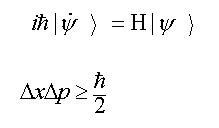
Schrodinger's Equation

From Schrodinger’s equation they derive the following formula:

Universal Wave Function

which predicts, through physical first principles alone, at the end of time that there must be an Intelligent Entity that is conscious, all-powerful, all-knowing, non-material, eternal. By all counts, such an entity would properly be called, “God”.

Tipler says in Dembski’s book Uncommon Dissent

(the chapter is available for free at ISCID at the link Tipler on Peer Review):

A recent poll of the members of the National Academy of Sciences, published in Scientific American, indicated that more than ninety percent are atheists. These men and women have built their entire worldview on atheism. They would be exceedingly reluctant to admit that any result of science could be valid if it even suggested that God could exist.

I discovered this the hard way when I published my book The Physics of Immortality. The entire book is devoted to describing what the known laws of physics predict the far future of the universe will be like. Not once in the entire book do I use anything but the known physical laws, the laws of physics that are in all the textbooks, and which agree with all experiments conducted to date. Unfortunately, in the book I gave reasons for believing that the final state of the universe—a state outside of space and time, and not material—should be identified with the Judeo-Christian God. (It would take a book to explain why!) My scientific colleagues, atheists to a man, were outraged. Even though the theory of the final state of the universe involved only known physics, my fellow physicists refused even to discuss the theory. If the known laws of physics imply that God exists, then in their opinion, this can only mean that the laws of physics have to be wrong. This past September, at a conference held at Windsor Castle, I asked the well known cosmologist Paul Davies what he thought of my theory. He replied that he could find nothing wrong with it mathematically, but he asked what justified my assumption that the known laws of physics were correct. At the same conference, the famous physicist Freeman Dyson refused to discuss my theory—period. I would not encounter such refusals if I had not chosen to point out my theory’s theological implications.

….
As a physicist, I am aware that quantum mechanics, the central theory of modern physics, is even more deterministic that was the classical mechanics of which Darwin was aware. More than this, quantum mechanics is actually teleological, though physicists don’t use this loaded word (we call it “unitarity” instead of “teleology”). That is, quantum mechanics says that it is completely correct to say that the universe’s evolution is determined not by how it started in the Big Bang, but by the final state of the universe. Every stage of universal history, including every stage of biological and human history, is determined by the ultimate goal of the universe. And if I am correct that the universal final state is indeed God, then every stage of universal history, in particular every mutation that has ever occurred, or ever will occur in any living being, is determined by the action of God.

Though I do not agree with all of Tipler’s ideas (forgive me Frank), the derivation from the Schrodinger equation above has been found reasonable by various scholars. And certainly having someone of John Barrow’s reputation as the principle co-author of the book where the derivation was originally given certainly lends a degree of respectability to the idea.

A reasonable possibility from physical laws alone is that ID has a Designer available at the cosmological scale. ID cannot answer whether the Designer of the cosmos is also directly the author of life. For example, we can say Rachmaninoff composed the famous Rachmaninoff 2nd Concerto. If God made Rachmaninoff’s ancestors, does this mean we can say God designed the Rachmaninoff 2nd? In like manner, we can’t be too quick to say God is the direct author of life even though the laws of physics may predict His existence. ID can only suggest that something is designed. However knowing, through the laws of physics, that God may exist, it certainly makes the design inference a little more palatable.

Salvador Cordova

  • Delicious
  • Facebook
  • Reddit
  • StumbleUpon
  • Twitter
  • RSS Feed

53 Responses to Peer-Reviewed Stealth ID Classic : The Anthropic Cosmological Principle (1987)

  1. Physcist and Mentok,

    I think your comments offer very reasonable skepticism and highlight very valid concerns. George Murphy (physicist and minister, and no friend of ID) was the one who introduced me to the idea. He commented though he didn’t fully accept the idea, he could not completely reject it either.

    I’m of the opinion, Barrow and Tipler have made a good enough case that it deserves more exploration. I don’t think the idea of the Omega Point as Tipler has formulated will succeed (sorry Frank), however, the idea of an Ultimate Observer seems at least plausible, if not inevitable.

    If every atom in the present is subject to a boundary condition defined in the future, it would stand to reason the future of every atom in the universe deeply influences the present state of that atom. By way of induction, the destination of the universe is more, or at least equally influential, than it’s past. This strikes me as a very straight forward and simple deduction.

    The double slit experiment (which is covered sophomore or junior university physics), no matter how wierd the results, makes sense mathematically, albeit in a very counter intuitive way. If a photon’s behavior in the present is affected by a future observation, why should this not be the case for every atom and every photon that ever existed? Thus, an ultimate observation seems like a reasonable and logical consequence of what we observe in the lab.

    I think the following reservation by physisict is very reasonable, however: “In fact, I suppose this lack of transfer of information somewhat scuppers the interpretation of the proposed final observer as a guiding/designing force.”

    Belinfante offers his idea regarding this, and I think I shall read his ideas some more. I think physcist concern here is worth giving one pause.

    I want to say, I appreciate all of the discomfort expressed over Barrow and Tipler’s ideas by several of the participants, and your objections evidence a reasonable and healthy level of skepticism. I appreciate your willingness to pond these ideas.

  2. scardova you wrote:

    “If a photon’s behavior in the present is affected by a future observation, why should this not be the case for every atom and every photon that ever existed?”

    How can any “affected behavior” of a photon be said to be caused by a future observation when we have no way of of ever seeing into the future in order to see the cause of the effect? If we see a photon being affected how is it possible to know that the cause of that behavior is from a future event? Since the future has not yet happened it seems to be impossible for any future event to directly influence the present. I can easily understand how a future event can influence the present if that future event is like the tomato analogy i.e of a goal set forth in the past for a future result which will affect our present time, but any theory which includes time travel needs to be better throught out.

  3. Mentok asked: “How can any “affected behavior” of a photon be said to be caused by a future observation when we have no way of of ever seeing into the future in order to see the cause of the effect? ”

    This is an inferenced based on the double-slit-delayed-choice experiement which the Shrodinger Wave funciton predicts. The result of the experiment demonstrated that present day choices affected the past history of a photon. That means for example, if we conducted an experiment over a vast distance, say on the order of the diameter of the orbit of Mars, my observation of a photon from mars at 6pm February 23,2006 is affecting the behavior of that photon in the past at 3pm February 23, 2006.

    If this is true, then it stands to reason the photons around us today are being affected by a future observation in the future.

    What is hard is not the idea, it is the acceptance of the idea. Let me encourage you to look at:
    http://www.geocities.com/sunja.....icles.html

    I sincerely appreciate your inquiry into this, and I’m sorry if I’m doing a poor job explaining. Please let me know if the above link was helpful.

    Salvador

  4. Scordova

    I’m glad you appreciated my comments. one good thing is that it at least encourages people to think about the weird things we definitely *do* know about quantum mechanics!

  5. scordova you wrote:

    “if we conducted an experiment over a vast distance, say on the order of the diameter of the orbit of Mars, my observation of a photon from mars at 6pm February 23,2006 is affecting the behavior of that photon in the past at 3pm February 23, 2006.”

    The problem with this theory is that it will always be impossible to verify it, and it goes against logic. The problem is the nature of time in that it is a continuous stream, there is no future and there is no past, there is only now at all times. There was a past and there will be a future but they do not exist. So nothing from the future exists, therefore there is nothing that can affect the present from non existent time, the same goes for the past.

    No one knows if time is continuous or quantized. Many suspect that both time and space must be quantized in any quantum theory of gravity. Here’s a nice discussion of it. -ds

  6. “As the great Nobel physcist Bohr said, “t if you aren’t confused by quantum physics then you haven’t really understood it.””
    Maybe so, but that doesn’t imply that if you ARE confused you HAVE really understood it.
    Although quantum physics is quite successfull it will probably be replaced at some point by an even more successfull theory that need not imply the things that some of you think quantum physics (and general relativity and what not) implies about the “ultimate observer”. There are plenty of examples of scientific theories which were claimed to be “equivalent” to some obscure passage in the bible (but of course in different words), but then later it turned out the scientific theory had to be rejected because of contradictory facts.

  7. scordova says: “In quantum cryptography, we can detect the effect of an intelligent intrusion into a crytographic system because someone’s intelligent choice has triggered a collapse. See: http://www.cs.dartmouth.edu/~jford/crypto.html

    By way of extension, because we see the universe, we are detecting that some agency is collapsing wave functions in the future.”

    But Scordova, quantum cryptography does not specify what things look like from within the wave uncollapsed wavefunction, which is where we would be right now, if some outside intelligence hadn’t collapsed our wavefunction. How do we know that both cases wouldn’t look identical and indistinguishable from each other? And since we can’t compare the two how possibly can we arrive at the “we must be in a collapsed wave function” conclusion?

  8. I did not say we are in a collapsed state, I pointed out future observation collapses our wave function. The considerations above where I mentioned the photons from Mars suggests that the photons emitted in the present might have an observation in the future. After all, what observed us to give definition to the physical world which constitutes our planet and our own minds and bodies?

    Salvador

  9. Sal says: “I did not say we are in a collapsed state, I pointed out future observation collapses our wave function. The considerations above where I mentioned the photons from Mars suggests that the photons emitted in the present might have an observation in the future.”

    I don’t see how this future observation requires any omnipotence.

    Sal says: “After all, what observed us to give definition to the physical world which constitutes our planet and our own minds and bodies?”

    On what grounds do you base your claim that we need to be observed to define our physical world? How do you know you aren’t living in an unobserved and uncollapsed wave function? Do you see what I’m asking? If you were living in an uncollapsed wave function, what would it look like?

  10. All this talk about quantum physics has left me thinking about a film I caught last summer titled “What the [Bleep] Do We Know?” Has anyone out there seen it, and if so, what are your feelings about it?

    Personally, I was fascinated by the sense of smarmy spiritualism that seems to go hand in glove with notions of quantum effects and observer-based reality. I found myself intrigued by what the film had to say, yet I was also rather dubious about a film showcasing commentary, on the one hand, by the likes of Drs. Fred Alan Wolf and John Hagelin, and on the other, by Ms. JZ Knight “channeling” the spirit of Ramtha the Enlightened One.

    By the way, in the coming sequel to “What the [Bleep”, called “Down the Rabbit Hole,” one segment is devoted to the famous double-slit experiment referenced above. I suppose the notion of the future shaping the past is counterintuitive, but then, if an electron behaves either like a particle or like a wave depending upon whether or not it is being observed, I would imagine there’s a lot of room for discussion.

    I saw part of it, decided it was a waste of time, and changed the channel. -ds

  11. “How do you know you aren’t living in an unobserved and uncollapsed wave function? ”

    You’re question delves into the possibility of no collapse. One solution is Everett’s many worlds. That is the photons around us that get emitted never get observed, they remain indeterminate. Reality splits off into may worlds. Your question, mathematically speaking delves into the possiblity of the Many Worlds Interpretation (MWI). In a sense it is not completely outrageous in as much as a quantum computer relies on a system being in multiple states simultaneously!

    However, there has been an experiment which would favor John Cramer’s transactional interpretation (TI), and thus this argues against the many-worlds interpretation (MWI). The experiment basically showed that the MWI of the quantum law was inconsistent with that law.

    danb asked, “If you were living in an uncollapsed wave function, what would it look like? ”

    I suppose, you would not know it from an unobserved one. You have made a good point in other words. However, for an unobserved universe to happen, then, the many world’s interpretation (MWI) would likely have to be true, but as I pointed out, that interpretation may have been experimentally demonstrated to be false, not to mention, that seems no less outrageous than to presume the existence of some all-powerful Observer.

    One thing that can happen however, is if the Ultimate Observer chooses to reveal Himself by some show of power at the end of time, then I would not presume it was an illusion if He so chose to do so. Experimental confirmation. I hold out hope that may one day happen. :-)

    “I don’t see how this future observation requires any omnipotence.”

    With respect to the universe, if the observation brought the universe into existence, it is all powerful by definition, at least with respect to this universe.

    Salvador

  12. Danb,

    If I may ask, do you think physics precludes the existence of the Ultimate Observer?

    I think Barrow and Tipler have certainly made a good case from science alone that He could exist. That is, the possiblity of some All-Knwowing intelligence is on the table, completely independent of religious texts.

    That in itself, at least give ID a possible “mechanism” for various features of the universe.

    Salvador

  13. Sal says: “However, there has been an experiment which would favor John Cramer’s transactional interpretation (TI), and thus this argues against the many-worlds interpretation (MWI). The experiment basically showed that the MWI of the quantum law was inconsistent with that law.”

    What experiment is this? Please do not keep us in suspense.

    Sal says: “With respect to the universe, if the observation brought the universe into existence, it is all powerful by definition, at least with respect to this universe.”

    Where did you look up this definition? Human observation is capable of collapsing wave functions. In fact, every wave function we’ve measured we’ve collapsed! Why aren’t humans capable of collapsing all of the universe that we can observe? (And since we haven’t seen any more than that, what’s left?) I’ll save the “source of the universe/source of God” argument for another time. I’m only concerned with what is required by quantum mechanics.

  14. Sal asks: “If I may ask, do you think physics precludes the existence of the Ultimate Observer? ”

    Of course, not. I’m just stating that physics does not require an Ultimate Observer. As far as I know, no one has proven or disproven God, or can. I’d be very suspect of any such proof anyway. There are many snake oil peddlers that just want to tell you what you want to hear. I wouldn’t suggest looking for confirmation of your faith in proofs. It kind of defeats the point of faith, doesn’t it?

    -Danb

  15. danb wrote: “Why aren’t humans capable of collapsing all of the universe that we can observe?”

    Technically speaking, we’ve collapsed the parts we have observed. We haven’t observed the whole universe, that would entail measurement of every atom. Saying you see a star, doesn’t imply that you’ve measured every quantum system in the star.

    danb wrote: “What experiment is this? Please do not keep us in suspense.”

    Rregarding the experiment:
    Professor John Cramer on Quantum Mechanics
    Professor John Cramer’s website:
    “A 50 minute discussion of quantum paradoxes and interpretations, with emphasis on new data (The Afshar Experiment) that appears to falsify the Copenhagen and Many-Worlds Interpretations, but is consistent with the Transactional Interpretation. “

    Cramer on QM

    I should note, although Cramer drops the need for an observer proximally, it does not negate the regress problem which leads to a non-material mind somewhere in the pipeline. The question of a regress to some ultimate cause remains as well as a regress to a non-material cause, even if the copenhagen interpretation has become antiquated.

  16. John Cramer’s website at University of Washington:
    http://faculty.washington.edu/jcramer/

  17. [...] I have said argued several times I think science can legitimately hypothesize God being a causal agent of nature. See Peer Reviewed Stealth ID Classic: The Anthropic Cosmological Principle (1987) for a discussion of the God hypothesis based purely on physics with no appeal to philosophy or theology whatsoever. [...]

  18. [...] In the Peer-Reviewed Stealth ID Classic : The Anthropic Cosmological Principle (1987), John Barrow and Frank Tipler argue the case for MWI. Several presumed the book was generally unfriendly to ID. For example see Barrow and Tipler on the Anthropic Principle vs. Divine Design by William Lane Craig. I highly respect Craig, but I will argue that Barrow and Tipler are more friendly to ID than they have been given credit for. [...]

  19. [...] [For the reader’s benefit, the science of the universal wave function and God are described here: Peer-Reviewed Stealth ID Classic : The Anthropic Cosmological Principle (1987).] [...]

  20. [...] Frank Tipler is a student of Wheeler. Tipler and co-author Barrow explicitly extend Wheeler’s hypothesis in Peer-Reviewed Stealth ID Classic : The Anthropic Cosmological Principle (1987). Instead Tipler and Barrow suggest some sort of Ultimate Observer in the distant future. They call their idea the Final Antrhopic Principle (FAP). The Ultimate Observer they call the Omega Point (I refer to it as Omega for short). They argue the properties of Omega must be that it is eternal, all-powerful, all knowing, non-material and intelligent. These properties are straight forward deductions of physical law…. [...]

  21. [...] In the case of engineered products we often might think of designers (plural) versus a designer (singular). It may be that some Ultimate Intelligence created the universe and (by way of extension) engineers. But even for those of us who accept that there is an Ultimate Intelligence, it is not customary to say that God made automobiles and airplanes and genetically engineered food. [...]

  22. [...] Tipler is author of The Anthropic Cosmological Principle (1987), one of the 3 ID books which began the modern ID movement. [...]

  23. [...] the thread Peer Reviewed Stealth ID Classic I point out Tipler’s comment: I discovered this the hard way when I published my book The [...]

Leave a Reply