Dave Thomas says, “Cordova’s algorithm is remarkable”
| August 17, 2006 | Posted by scordova under Intelligent Design |
Dave Thomas is in a bit of a tizzy over my humble offering: Tautologies and Theatrics (part 2): Dave Thomas’ Panda Food. He responds at Pandas Thumb with: Calling ID’s Bluff, Calling ID’s Bluff. I thought I’d alert the readers at UD what horrible things I’m accused of, that I might be some sort of vile scoundrel.
[Dave writes:]
Imagine my surprise, then, when I found Salvador Cordova at Uncommon Descent spewing blatant falsehoods about this work. I was shocked – shocked, I say – to catch the UD Software Engineers in a lie. And quite a lie it is – with the help of mathematicians like Carl Gauss, I’m going to lift the veil from the obfuscations of IDers, and prove it’s a Lie, much as you would prove a mathematical theorem.
….
which the brilliant Gauss found useful
Thomas then correctly identified the formula I implemented via Genetic Algorithm:
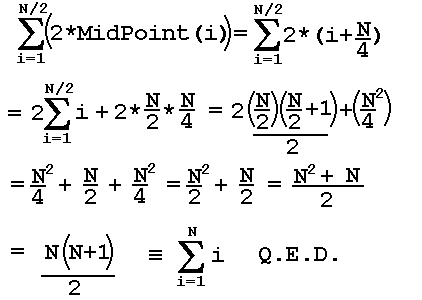
![]()
[Dave writes:]
The Software Engineering Team of Uncommon Descent has been caught lying – Q.E.D.
Where did I ever claim there wasn’t smoke and mirrors involved in the gimmickery here? Fer cryin’ out loud, my post was talking about mathematical theatrics, and I presented that program as an example of gimmickery! I even alerted the reader with these words before presenting my program, “The following [are] computational theatrics”. Sheesh!
[Dave writes:]
As an exercise in Smoke and Mirrors, Cordova’s algorithm is remarkable
Well dog gone, he actually says something nice about my work. It’s REMARKABLE!
I fully take pride in the smoke and mirrors I used, I never pretended otherwise. In contrast, Thomas refuses to admit he’s also using smoke and mirrors in his GA. He pretends somehow his steiner-solving program should persuade us that mindless undesigned forces can hit specified targets.
Well, did he have some Chimpanzee create the fitness functions in his software for him? Without intelligent design on his part, his fitness functions will fail to guide the system to the intended target. He has thus snuck the answer his GA, much the same way I snuck the answer in my GA. At least I alert the readers of where the trickery is, but Thomas would rather have his faithful congregation at Pandas Thumb believe that mindless evolution can truly work magic.
As Haeckel said:
Evolution is henceforth the magic word by which we shall solve all the riddles that surround us.
Ernst Haeckel1
Instead of “abracadabra” the Pandas say, “evolution”. Ramen.
78 Responses to Dave Thomas says, “Cordova’s algorithm is remarkable”
Leave a Reply
You must be logged in to post a comment.
Salvador,
“The displacement theorem describes the likelihood as more remote than random chance on average.”
It seems to me that the displacement theorem does not apply. The problem here is not like finding a particular amino acid sequence, as in Dembski’s “Searching Large Spaces.” That is, the problem is not to find an element of a small target, where elements outside the target are of no utility. Instead, any network that spans the fixed nodes is usable. There are a great many such networks. Some are better than others. You might argue that the set of Steiner solutions is the target, but, unlike Dembksi’s search assistant, the fitness function does not “know” which networks are Steiner solutions. There are local maxima in the fitness landscape, and the fitness function does not do anything to assist the GA in finding global maxima (Steiner solutions). This seems to me not to fit Dembski’s paradigm of assisted search.
“No one has yet been able to demonstrate that a GA can popup out of nowhere on its own. NO ONE!”
That’s in part because of the weirdness of your statement. No one claims that nature created a GA. Humans devised the GA as an abstract model of a natural process. The natural process of evolution arises by necessity when a population of self-replicators competes for resources in a bounded arena. Variation in the population arises from errors in replication necessitated by thermodynamics. The boundedness of the arena necessitates that some variants are culled from the population. Evolution is necessity operating on chance inputs.
A better version of your remark: No one has yet been able to demonstrate that a self-replicator can pop up out of nowhere on its own. NO ONE!
“… GA’s do not demonstrate that undesigned nature can evolve complex designs from scratch.”
You have a concept of undesigned nature? If I demonstrate to you that novel information in biota comes from random errors in reproduction and specificity comes from the environment (i.e., by way of selection), you’ll have no choice but to tell me the environment was designed. Am I wrong?
Others have pointed out why the displacement theorem does not apply. But for the sake of argument, let’s consider random chance: It seems clear that every existing species could in principle be generated by random chance, simply by exhaustively sampling the space of possible DNA sequences. While maximally inefficient, such an algorithm would eventually be successful. Therefore, if the design of living creatures embodies CSI, then random chance can create CSI.
So it seems that the argument ultimately boils down to one of efficiency. Is a parallel heuristic sampling algorithm such as a genetic algorithm able to discover CSI (or whatever type of information is required to define an organism sufficiently efficiently? This is not a question that could be resolved by some sort of law of information conservation, even if such a thing could be established, because it is a kinetic questionâ€â€now a question of whether it can happen, but whether it can happen fast enough to be consistent with observation.
trrll wrote:
Formatting error: trrll’s blockquote should have ended after the first paragraph in the previous comment. Sorry.
P.S. Will UD have a comment “preview” function after the coming upgrade?
Mark Frank (48):
This simply isn’t true. Use of various (computer-based) numerical methods to help find optimal, or at least adequate, solutions is a standard part of perhaps most engineers’ educations. Necessarily, when these methods are used, the engineer doesn’t know what the solution will be beforehand, but he or she must know enough to choose and set up the method in a way that it may yield a solution. I’ve already given an example of this in another thread: the solution of a system of nonlinear equations (that models some real-world problem) using an algorithm such as the Newton-Raphson method.
He did design them. If it wasn’t for his intention, they wouldn’t exist. What he didn’t do is specially create them. Intelligent design is not creationism.
If the Displacement Theorem does not apply then the target lacked high specificity ( high specificity means highly improbable), which means Thomas’s program cannot be a counter example to CSI conservation. This would be equivalent to launching an arrow and saying where ever it landed it hit a target.
But even that may be too generous if the software guarantees solutions which create connectivity (albeit of unknown length). If then we calculate the ratio of all possible connected networks versus all possible unconnected “networks”, then CSI is implicated, and the displacement theorem applies.
Thomas’s describes his fitness function in his original essay Target? TARGET? We don’t need no stinkin’ Target!:
In outher words we have 2 situations:
1. If Displacement theorem doesn’t apply, then the GA cannot be used as a valid counter-example to ID claims
2. If the Displacement theorem applies, then we may be able to find how the CSI was snuck in. There is an extreme caveat here, discovering the how is a sufficient, but not necessary condition for affirming the displacement theorem. It may be the GA program is so complex, it defies analysis how the CSI was snuck in. For example, a fitness funciton may have been discovered by the designer through serendipity which he may or may not understand why it works. Meaning, random hacking of the fitness function on his part may create a local optimization, just as your paper (correct me if I’m wrong) suggested could be easy. But even such random hacking to achieve a goal is assisting the search. If the solution space is structured a certain way, then on rare occasions the quest for optimiztion may actually result in genuinely informed (learned) strategy.
Re #65. I would like to continue this discussion but I am finding that only about 50% of my postings on UD are accepted and others are delayed by up to 24 hours (I am not aware of breaking any of the rules). This makes it almost impossible to have an intelligent debate. It also takes considerable time and effort to make a thoughtful and relevant response and it is too frustrating to do this and then find it is rejected without explanation
There doesn’t seem to be any logic as to why some posts are accepted and others are not. It makes me wonder if it is actually a technical or process problem rather one of censorship.
Let’s see if this one makes the grade
This is certainly a very narrow idea of design. The method of working backwards from a known goal is clearly a useful design strategy, and the inability of evolution to use this strategy is clearly the source of many of the infelicities of the design of organisms, but it is hardly the only strategy available to a designer. Two other important sources of design are:
1) Discovery/serendipity: This is arguably the most important modality of design, in which discovery of the means precedes awareness of the goal. Typically, a designer working on some other problem entirely discovers a means of achieving an end that he did not previously even conceive as a possible goal. For example, until the discovery of the laser, nobody would have imagined using optical storage for movies. Indeed, shortly after its discovery, the laser was described as “a solution in search of a problem.” Truly transforming discoveries typically arise in this way.
2) Trial and error solution to a problem: Edison reportedly tried hundreds of possible filament compositions in his search for a way of making a light bulb. Historically, much pharmaceutical drug development is derived from testing a large number of chemical compounds in animal models, picking those that seem to produce useful effects, and only later figuring out how that particular compound produces those effects.
Mark Frank,
If it makes you feel better, my posts get held up as well. Let’s be patient with the volunteer work of the moderators however.
If you are on my threads, and you abide by the spirit of the forum, and I remove something of yours, it will appear on the Cutting Room Floor.
Thank you by the way for visiting.
Salvador
Re #69. Thanks Salvador. I will restrict my involvement to your threads and see how it goes.
Re #65. There is a difference between designing a method for finding a solution and designing the solution. Dave designed a method for producing patterns with short path lengths but he didn’t design the patterns.
Here’s an analogy. I want to find a solution to a difficult mathematical problem. So I organise a competition and offer a prize to the first person to solve it. I designed the method of finding the solution (the competition) but the winner designed the solution. The winner would be justifiably pissed off if I claimed I had designed the solution because “without my intention the solution would not have existed”.
In the case of Newton-Raphson (and indeed Salvador’s example) there is an additional complication – the solution is a single number. You can’t design a number. You can come up with a design which you express as a single number – but that number must represent something more complex where the designer has to think through how the solution solves the problem. This is confusing because it means that in these examples the only occurence of design is in the method of finding the solution – not the solution itself.
Re #68.
Neither 1 or 2 are in conflict with my conditions (a) and (b). 1 and 2 are methods for coming up with a design. This could happen through serendipity, a blinding flash of inspiration or a visit from my fairy godmother. However, once the design has been produced conditions (a) and (b) must still apply for it to be a design and not just a happy accident.
Rgds
Two more modes of design:
3) Subconscious daemon (initiated by previous conscious effort). Mathematician Henry Poincaré, after intensive periods of deliberate, conscious effort searching for what he called Fuchsian functions:
4) Conscious inspiration. Mozart:
(Both quotes from Roger Penrose, The Emperor’s New Mind)
Mark Frank,
As I strongly implied @65, you are using the word “design” in too strict a sense. You’re using it as a synonym for “specially create.” The more general definition is what ID concerns. An engineer who uses a computer program to find a solution (that correspond to a design) is considered the designer. And it’s true. He had “held a particular purpose in view” and undertook “deliberate purposive planning” and “laid down means to an end in a scheme” (See my comment #46)
The organizer of a design competition cannot be said to have designed anything. The proper description of their activity would be “facilitation.” Yes, I did write “If it wasn’t for his intention, they wouldn’t exist.” But having the intention is a necessary, though not sufficient, condition for designing something. Obviously, anyone who ever intended to design an airplane before the Wright brothers actually succeeded cannot be credited with designing an airplane. But this is what one would be led to by your interpretation of what I wrote. One has to actually come through with the goods to be considered an inventor. For example, patents aren’t issued to business owners, they’re issued to the employees who contributed substantively to the design.
I don’t quite follow what you mean regarding the Newton-Raphson method.
â€â€Ã¢â‚¬â€Ã¢â‚¬â€Ã¢â‚¬â€Ã¢â‚¬â€Ã¢â‚¬â€Ã¢â‚¬â€Ã¢â‚¬â€Ã¢â‚¬â€Ã¢â‚¬â€
Your (Mark Frank’s) criteria @48: “(b) [to be considered a design, it must] achieve the designer’s purpose in the fashion that the designer planned.”
You @70: “Re #68. Neither 1 or 2 [@69] are in conflict with my conditions (a) and (b). 1 and 2 are methods for coming up with a design. This could happen through serendipity, a blinding flash of inspiration or a visit from my fairy godmother. However, once the design has been produced conditions (a) and (b) must still apply for it to be a design and not just a happy accident.”
This makes no sense. If the design existed before the designer even intended to design anything, or if the design is found only by a process of elimination, it cannot be in the fashion that the designer planned.
M-W’s dictionary:
And my modes (3) or (4) don’t meet your criteria, either.
j
Let’s start by summarising where we agree.
1) You say “having the intention is a necessary, though not sufficient, condition for designing something”. I absolutely agree. Dave had the intention to create patterns with short path lengths – but that is not sufficient to prove that he designed them.
2) In the case of the competition the organiser cannot be said to have designed the solutions (although he did design the process which lead to the solutions being designed).
I believe that Dave was in the position of the organiser. He created a process where solutions emerged. I can perhaps convince you by imagining a small change to his algorithm. At the moment it creates new patterns through random mutation and crossover of “DNA”. It then selects through choosing the ones with the shortest path length. It is the selection process that Salvador considers to be point where Dave adding his design. OK let’s keep the selection process but change the variation process. This will mean moving the algorithm off a computer. The organiser will start by asking many small children to come up with their best solution to Dave’s problem. The organiser will then subject these solutions to Dave’s selection algorithm (i.e. select the ones with shortest path length) and hand them back to the children to try to find improvements (probably we mix them up so a child is not trying to improve another child’s solution – not their own). The children hand in their improvements and we run them through the selection algorith and do it all again until it looks like we aren’t getting anywhere (assume these are extraordinarly indefatigable children). This looks very like the competition except it has multiple rounds. I seriously doubt you that could say the organiser was designing the solutions – the children are doing that. But the element that Salvador labelled as introducing design (the selection algorithm) is identical. What has changed is the source of variation.
With respect to 1 and 2. You need to be precise about what happens. If Edison simply kept putting things between two electrodes in the hope that one would one day light up – then I don’t think you can say he designed that solution. He just discovered it. He also designed the process for finding a solution (trial and error). If he thought about the kind of properties that would be required for a light bulb, selected suitable elements, tried them out, and the worked out how to package them into a usable offering then he did design the solution and a bit of trial and error helped out. But Dave’s algorithm is not at all like that.
Rgds
You imply that the children use their intelligence in the generation of the proposed solutions. This being the case, then of course they are to be credited with being co-designers with whoever designed the algorithm used to choose among the proposals. However, if they had been generating their proposals by the roll of dice (for example), then they are not to be credited with having contributed to the design. They would have been slavishly implementing a mindless process. A designer is one whose choices lead to a solution. If those choices can be automated (as in Dave Thomas’s program), it makes no difference. All who makes the choices (which algorithm to use, how to initialize it, what “the fittest” is defined as, possibly how to tweak the algorithm, etc.) that result in the solution, is/are the designer/s.
Your evaluation of Edison agrees with this. You say that if his solution was obtained completely by chance, then he did not design it, but if he made choices that were essential to permitting the discovery to be made, then he did design it. Dave Thomas made choices that were essential to permitting the discovery of the Steiner solutions.
I could easily take your hypothetical introduction of intelligent agents into the variation process as an apparent sly ploy to make it seem more reasonable that a totally blind/dumb/purposeless process has powers that it doesn’t have. (Like Darwin comparing natural selection to artificial selection in the Origin of Species.) But I’ll be charitable and assume this wasn’t the case.
[P.S. I'm getting bored with this particular topic and plan to move on.]
j. I am sorry you are bored with this topic. To my mind we got to an interesting point. It gives me an opportunity to have the last word – but please understand this is purely in a spirit of intellectual enquiry.
In my proposed example with children you cleverly use the word “co-design” but the organiser is doing no more than the “facilitator” of the maths competition – simply selecting the best solution out of many submissions – and we earlier agreed that the facilitator was not a designer. If you accept that selecting the best of several designs is not designing the solution, then your logic seems to imply that whether the organiser designed the solution depends on what the children do and not on what the organiser does. Suppose the organiser did not know whether the proposed solutions were created through intelligence or the roll of the dice?
I will keep checking for a few days in case you (or anyone else) feels moved to respond but will understand if that is the end of the discussion. Thanks for attending.
[This is why I said I plan to move on.]
You: “…but the organiser is doing no more than the ‘facilitator’ of the maths competition…” I don’t agree. Because you changed the rules midstream.
Back at (70) you said: “I want to find a solution to a difficult mathematical problem. So I organise a competition and offer a prize to the first person to solve it.” (boldface added) That is why I said that the organizer did not design anything. The organizer did not influence the design, s/he accepted it as presented. I make myself more likely to find a [Widget To Accomplish Some Task] if I take a trip to Sears, or use Google. That doesn’t mean I designed the [WTAST]. I may not know whether the [WTAST] even exists ahead of time. But if I’m willing to expend some effort, I can increase the likelihood of finding it — I can facilitate its finding.
But then at (73), you made a crucial change to the role of the organizer: “The organiser will then subject these solutions to Dave’s selection algorithm (i.e. select the ones with shortest path length) and hand them back to the children to try to find improvements…” You added his/her selectivity to the process of achieving the end product. That is why I said that the organizer is a co-designer.
And I maintain that Dave Thomas can be considered the designer (not special creator) of the Steiner solutions. It is only because of the teleology that he imparted to the system that the solutions were obtained.
j You are right – I apologise. I forgot what I wrote. So I need to adjust the argument a bit.
Suppose you go on to Google and you choose the fastest widget. Did you therefore contribute to the design of that widget? To make it concrete suppose you wanted an external disk drive and you selected the one with the fastest access time subject to a minimum capacity. I think the manufacturers might be surprised by your claim to have contributed to the design.
You may object that the disk drives were created before the selection process. But that is exactly what happens with Dave’s selection algorithm (or any selection algorithm). It selects from what already exists. It is only the repeated application of the algorithm that hides this rather obvious point. So if selection algorithms are part of the design they have the weird propery that the design takes place after the solution has been produced.
“I think the manufacturers might be surprised by your claim to have contributed to the design.”
Yeah, if I accepted the disk drive as presented. But if instead the manufacturer had no clue what to do to improve the disk drive other than from my selection of random variants of it, then I think I’d have every right to claim to have designed the improvements to it. (Or the entire disk drive if this process started from scratch.)
“So if selection algorithms are part of the design they have the weird propery that the design takes place after the solution has been produced.”
No they don’t. They have the property that design takes place after slight improvement has been produced. Again and again and again. The solution is produced only after much design has occurred.