Home » Evolution, Intelligent Design, Religion, Science, theistic evolution » The End of Christianity now available at Amazon.com

The End of Christianity now available at Amazon.com

Although its official release date is not until November 1, THE END OF CHRISTIANITY is now in stock and being sold at Amazon.com (go here). Even though argument in this book is compatible with both intelligent design and theistic evolution, it helps bring clarity to the controversy over design and evolution. In particular, it resolves the problem of dysteleology and natural evil by introducing a conception of the Fall that is theologically sound and also compatible with modern science (i.e., with standard astrophysical and geological dating that places the earth and universe at billions of years old).
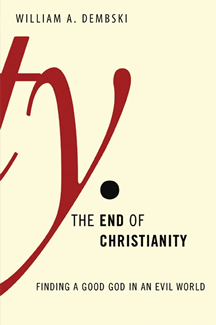
THE END OF CHRISTIANITY

  • Delicious
  • Facebook
  • Reddit
  • StumbleUpon
  • Twitter
  • RSS Feed

43 Responses to The End of Christianity now available at Amazon.com

  1. And here:

    With the scriptures it is a matter of treating about the faith. For that reason, as I have noted repeatedly, if anyone, not understanding the mode of divine eloquence, should find something about these matters [about the physical universe] in our books, or hear of the same from those books, of such a kind that it seems to be at variance with the perceptions of his own rational faculties, let him believe that these other things are in no way necessary to the admonitions or accounts or predictions of the scriptures. In short, it must be said that our authors knew the truth about the nature of the skies, but it was not the intention of the Spirit of God, who spoke through them, to teach men anything that would not be of use to them for their salvation.

    De Genesi ad literam, 2:9

    Interesting; St. Augustine anticipated Stephen Jay Gould’s argument for non-overlapping magisteria (i.e. “NOMA”) by a millennium and a half…

  2. As a YEC myself, I’d really like to hear someone’s input on Paul Giem’s technical analysis of the various radio-isotope dating methods which are so often referenced as solid proof for an old earth. The articles can be found here:

    Part 1

    Part 2
    Part 3

    I’m not yet at level advanced enough in math to understand some of the more technical parts, so I was wondering if anyone else had a knowledgeable opinion?

    Anoterh interesting thing that I’ve come across contradicting the old-earth/uniformitarian mindset would be petrified trees standing in the upright position that penetrate through multiple layers of sedimentary rock spanning millions of years according to dating methods. I find this observation particularly interesting because not only is this phenomena seen on every continent in the world, but it’s been empirically observed and repeated on smaller scales during flooding/mud slides/volcanic activity.

    A relevant article:
    Polystrate Trees

    Also the uniformitarian/old-earth view seems to discount the possibility of a global flood, or at least the implications of a global flood and its consequent impact on radiometric dating. More recent research has surfaced in support of the accelerating effect a global flood would have on radioactive decay rates via cavitation.

    Reference here:
    Accelerated decay of radioactive thorium

    Just at least some things to keep in mind at the very least.

  3. How Long Are The Genesis Creation Days? – Hugh Ross
    http://www.youtube.com/watch?v=aKGT1T8O7zU

    Do the RATE Findings Negate Mainstream Science? GREG MOORE
    Excerpt: The RATE conclusions are based on a compounded set of assumptions. These assumptions are not derived from empirical data, but from the young-earth view of Earth history. Until the RATE team can demonstrate the validity of these assumptions, the study’s findings do little to prove the accelerated decay hypothesis.
    http://wwwold.reasons.org/chap.....200707.pdf

  4. A better link:

    Do the RATE Findings Negate Mainstream Science?
    http://www.reasons.org/resourc.....eamScience

  5. Amazon’s note that my copy of this book is on the way came the other day and so I’m anxious to get it and read it. Prof. Dembski is to be commended for putting on his theological hat and tackling theodicy. The genious of ID is that it separates the question of design from the issue of evil. In my experience the ultimate evidence for Darwinism is the evil in the world—that God wouldn’t have done it that way.

    Anyway for the history of <creatio ex nihilo I recommend Gerhard May.

    The first word of Genesis is a construct noun, which means that it cannot mean ‘in the beginning’ but rather must mean ‘in the beginning of …’, as Rashi and many other exegetes ancient and modern have noted. Here, however, there is no absolute noun (the beginning of what), which adds to our difficulty. Rashi cites as similar Isaiah 46:10 (“Declaring the end from the beginning”) where there is no absolute noun. He suggests an understood absolute, dabar ‘word, thing’, i.e., “Declaring the end of a thing from the beginning of a thing.” [hmm … in the beginning was the word]

    The New Testament employs the expression, “from beginning of creation” (e.g., Mark 10:6; 13:19; 2Peter 3:4; with vocabulary reflecting Genesis), and in the book of Revelation (3:14) the Messiah is called, “the beginning of the creation of God.” Thus Genesis could be understood as, “In the beginning of [it, i.e., the creation, the covenants, Adam, Israel, Messiah, etc.] God created the sky and the land.” Creatio ex nihilo may be a valid doctrine, but it is in no way forced in Genesis 1:1.

    Rashi also argues that verse 1 does not say that heaven and earth “were created prior and the meaning is, ‘In the beginning of everything he created these.’” Rather Rashi shows that in Genesis things seem to exist before the mention of their creation, and thus he concludes, “Upon your indulgence the verse does not teach the order of what is earlier and what later at all.” Recently John H. Walton has argued, cogently I believe, that Genesis does not speak to physical origins so much as to assigning functions. Thus in verse 14, “And God said, Let there be lights in the firmament of the heaven to divide the day from the night; and let them be for signs, and for seasons, and for days, and years …” It need not be that on the fourth day that God created the sun, moon, and stars (after he had created the earth and seas on the 3rd day and the heavens on the 2nd), but that he was assigning these entities their functions.

    Walton can give the impression that Genesis is a primitive attempt to explain what the functions of the physical are, for he allows that God can use a false understanding, such as that the sky is a solid dome, to get across his point, and he never develops what larger “spiritual” significance these functions might symbolize. This is difficult for moderns, even believers, but was par for the course for chazal and the church fathers, which if you are interested in that line of reasoning I think John V. Fesko is a pretty good place to start.

    I also fault Walton for bringing up Intelligent Design when, as a theistic Darwinist, he really doesn’t get it. The Bible is abundantly clear that God is the hands on creator of the natural world and architect of world history. But I think Walton is correct when he says that the six days of Genesis do not describe the creation of the physical world. My own take is that they describe symbolic events that transpired over a period of seven days at the beginning of biblical chronology, events that symbolized the plan of God and are described at the beginning of the Book as a sort of Table of Contents.

    For good conservative critiques of all this I recommend Victor P. Hamilton and C. John Collins.

    Collins, C. John. 2006. Genesis 1-4: A Linguistic, Literary, And Theological Commentary. P & R Publishing.

    Fesko, John V. 2007. Last Things First: Unlocking Genesis 1 – 3 with the Christ of Eschatology. Fearn, Scotland: Mentor Imprint.

    Hamilton, Victor P. 1990. The Book of Genesis 1-17 New International Commentary on the Old Testament Series. Wm. B. Eerdmans Publishing Company.

    May, Gerhard. 2004. Creatio Ex Nihilo. T. & T. Clark Publishers.

    Walton, John H. 2009. The Lost World of Genesis One: Ancient Cosmology and the Origins Debate. IVP Academic.

  6. Allen_MacNeill,

    Quoting Augustine:
    “I have, insofar as I was able, explained in detail and set forth for consideration the meanings of obscure passages [in Genesis], taking care not to affirm rashly some one meaning to the prejudice of another and perhaps better explanation.”

    What were the meanings that he set forth?

  7. Allen MacNeill’s Augustine and Gould’s NOMA are obviously attempts to delegitimize religion and Scripture as sources of knowledge—comfortable fantasies and useful fictions maybe—but not public knowledge, as Phillip Johnson so astutely perceived.

    The reactionary materialist understands that the Exodus and the Resurrection cannot be refuted, but he thinks he has refuted Genesis. In fact one could say that the modern secular state as it has evolved in the past half century is founded on two pillars: Genesis got it wrong and Darwin got it right. It is for this reason that Genesis is important for cultural conservatives. If Genesis really did get it wrong then the Bible must be more what the liberals wish than conservatives think.

    In view of this I think it important that the difficulties in Genesis be recognized. It was difficult even for the ancients, and more has been written on Genesis One than on any other passage in the Bible. Those who insist that any particular interpretation, no matter how well sanctioned by tradition, be the last word on the subject are in danger of refutation by facts on the ground.

    Now I want no part with the mushy liberal theologians who, as I remember Richard Feynman noting, will never risk saying anything that could possibly be proven wrong. But what we do need is the resilience to adapt our interpretations as new facts arise.

    Perhaps it’s not Genesis that got it wrong but rather our interpretations.

  8. St. Augustine attempted to delegitimize religion?

  9. —-Allen MacNeill: “Interesting; St. Augustine anticipated Stephen Jay Gould’s argument for non-overlapping magisteria (i.e. “NOMA”) by a millennium and a half…”

    No, not really. Augustine’s position was that God created us to think His thoughts after him. In other words, faith and reason are compatible. His motto has been described as “faith seeking understanding.”

    Aquinas reversed the emphasis to something like, “I understand in order to believe.” For both men, however, faith and reason were complementary. Augustine clearly did not accept anything like Gould’s “non-overlapping magesteria.”

    The Christian doctrine is consistent with the unity of truth, meaning that one truth exists though it can manifest itself in multiple ways, as opposed to the notion that there are multiple truths. To posit multiple truths is to hold that there really is no truth at all.

  10. Mystic wrote: “Having read the book, perhaps you can address my earlier post, which was held up in moderation:

    What perplexes me about you [Dr. Dembski] and ID is your transition from characterizing the intelligence of the Designer of life as non-natural, as Phillip Johnson did, to characterizing it as natural. Does your book explain your change in perspective? In any case, would you please explain it to us now?

    Sorry, Mystic, I only read enough of the book to get general idea of Dembski’s theodicy. I’m not sure if he addressed your question.

    JGuy wrote: “Bill, thanks for the clarification.

    is to argue that just as the salvation in Christ at the Cross saves backward in time as well as forward (the OT saints were saved in virtue of the Cross), so the effects of the Fall can be retroactive.

    Without spilling the book into the comments section, I am curious as to how you might make that argument.

    Simple: God is not bound by time, and therefore is able to effect events in the past based on what he knows will happen in the future.

  11. Re StephenB (#40)

    On the topic of faith and understanding: the phrase “Faith seeking understanding” was actually the motto of St. Anselm (1033-1109). However, as StephenB correctly points out, this saying is based on the words of St. Augustine (354-430), who followed it up with a complementary truth: “I believe, in order to understand; and I understand, the better to believe” (Sermo 43, 7, 9: PL 38, 257-258).

    Kenneth Richard Samples, in his online article, St. Augustine of Hippo: Rightly Dividing the Truth (Part 2 of 2), at
    http://www.reasons.org/people/.....ding-truth , does a very good job of explaining how faith and understanding complement each other:

    In his Sermon (43.7, 9) Augustine asserted: Crede, ut intelligas (“Believe in order that you may understand”).12 For Augustine, faith (“trust in a reliable source”) is an indispensable element in knowledge. One must believe in something in order to know anything. Knowledge begins with faith and faith provides a foundation for knowledge. Faith is itself indirect knowledge (like testimony or authority). While faith comes first in time, knowledge comes first in importance. Faith and reason do not conflict, but instead complement one another. Augustine believed that while reason does not cause faith, reason everywhere supports faith. Augustine also argued that Christians should seek to use their reason to understand doctrines (the Trinity, Incarnation, etc.) that are given via divine revelation (thus “faith seeking understanding”). Augustine’s writings about the role of faith influenced Credo, ut intelligam (“I believe in order that I might understand”) by St. Anselm (a.d. 1033-1109).

    Faith and understanding, properly understood, do not conflict. Nevertheless there is a popular misperception that they do, as well as some confusion as to which should come first.

    This imagined conflict goes back to a twelfth century theological quarrel between St. Bernard and Peter Abelard, who was accused of turning the rule, “Unless you believe, you shall not understand” on its head (a rule based on a loose Septuagint translation of Isaiah 7:9). The original Hebrew is more accurately rendered: “…you will not persist.”

    In his Historia Calamitatum (The Story of My Misfortunes, Chapter IX), Abelard says that his reason for writing theological treatises was at the request of his students, who, he says, “were asking for human and logical reasons on this subject, and demanded something intelligible rather than mere words. In fact they said that words were useless if the intelligence could not follow them, that nothing could be believed unless it was first understood, and that it was absurd for anyone to preach to others what neither he nor those he taught could grasp with the understanding” (emphasis mine – VJT). Dr. Ralph Norman speculates in his article, Abelard’s Legacy: Why Theology is not Faith Seeking Understanding in the in Australian EJournal of Theology, Pentecost 2007, Special Edition) that Abelard’s statement here, nec credi posse aliquid nisi primitus intelligetis, could have been a deliberate play on Anselm’s motto, fides quaerens intellectum.

    However, scholars who are familiar with the writings of Bernard and Abelard have concluded that the controversy between the two was a theological storm in a teacup. Thus M. T. Clanchy, in Abelard, A Medieval Life (Blackwell Publishers Ltd., paperback, 1999) concludes that St Bernard and Abelard were at cross-purposes here, as they were using “understand” and “estimate” (one of Abelard’s terms for “faith”) to describe different stages in getting to know something.

    (Pages 35-36)
    Bernard turns on Abelard, as if he were actually present in the room where this letter was being dictated, and reproaches him for his temerity: ‘You whisper to me that faith is an ‘estimate’ and you mutter about ambiguity to me, as though nothing were certain.’27

    Abelard had indeed defined faith in his Theologia as an ‘estimate’ of things which are not apparent.28 He and St. Bernard were operating at cross-purposes here, rather than really disagreeing about fundamentals.
    By ‘faith’ Bernard meant ‘conviction’, a psychological experience deep in the mind. He cited St. Augustine: ‘Faith is not in the heart of anyone who has it only as a conjecture or an opinion; but it is certain knowledge acclaimed by the conscience.’29 A person has ‘certain knowledge’ – (certa scientia) of something, when his ‘heart’, which is the centre of the emotions, combines with his faculty of knowing (conscience – conscientia) – to form a conviction. Abelard’s defintion of faith as an estimate focused on an earlier stage in the psychological process… In his treatise on how the mind works (De Intellectibus), Abelard had distinguished between ‘understanding’ (intellectus), ‘estimating’ (existimatio) and ‘knowing’ (scientia). A proposition has to be understood first of all, regardless of whether it is true or false. Next comes the process of ‘estimating’ or assessing whether the concept, now formed in the mind, should be believed. ‘If I do not give credence to the concept’, Abelard says, ‘I believe it is not as I conceive it to be.’31 Finally, there is the stage of ‘knowing’, which is the state of ‘certitude of mind’…

    (Page 283)
    St Bernard and Abelard, and St Anselm and Abelard, were at cross-purposes here, as they were using ‘understand’ and ‘estimate’ to describe different stages in getting to know something. A proposition has to be understood (that is, it has to make some sort of sense), before an estimate can be made of whether to believe it.115

    Clanchy’s comments can be viewed at http://books.google.com/books?.....AwQ6AEwAA#

    and at

    http://books.google.com/books?.....38;f=false

  12. Allen_MacNeill,

    Thanks for that. That’s the quote I was thinking of.

Leave a Reply