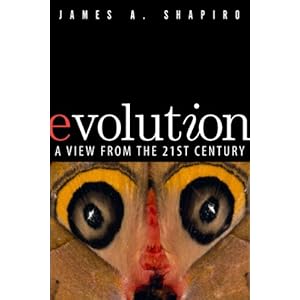
Is cell biologist James Shapiro a heretic? Or is this the year Darwinism collapsed?
| June 14, 2011 | Posted by News under Darwinism, Evolution, Informatics |
Look what University of Chicago’s James Shapiro is saying,
New research has shown that a novel way of looking at evolution is needed. Cells are sensitive and communicative information processing entities. Novelty in evolution comes in part from genome changes that are the result of regulated cellular activity. The next step in the understanding of evolution is emerging since the Modern Synthesis of Darwinism and Mendelism and the discovery of the double helix structure of DNA in the middle of the last century. Vid also. Slides here.
He says the new way is informatics. And it’s okay for an establishment guy to just say this stuff?:
Disentangling basic issues in evolutionary debates
1. Origin of life & the first cells – still on the fringes of serious scientific discussion
2. Descent with modification of related living organisms – more convincing with each new technological advance (e.g. detailed protein and genome phylogenies)
- but more complicated than simple vertical inheritance
3. The actual processes of evolutionary change over time – an ever growing number of distinct documented cellular and molecular events different from conventional predictions
- novel molecular possibilities of genome reorganization as we learn more about how cells interact and control genome structure
and (besides the part about non-Darwinian biologists)
Four kinds of rapid, multi-character changes Darwin could not have imagined• Horizontal DNA transfer in evolution;
• Multiple cell types and cell fusions (symbiogenesis) in evolution;
• Genome doublings at key steps of eukaryotic evolution;
• Built-in mechanisms of genome restructuring = natural genetic engineering
His new book, Evolution in the 21st century here.
Follow UD News for breaking news on the design controversy.
38 Responses to Is cell biologist James Shapiro a heretic? Or is this the year Darwinism collapsed?
Leave a Reply
You must be logged in to post a comment.
2. Descent with modification of related living organisms – more convincing with each new technological advance (e.g. detailed protein and genome phylogenies)
Here’s a quote:
Darwinian orthodoxy cannot possibly survive in the information age. It’s really quite simple: Computer programs can’t and don’t write themselves, but this is what Darwinists would have us believe.
It was a nice try until the discovery in the latter half of the 20th century that life is fundamentally based on information-processing systems, and not mindless, materialistic, stochastic mechanisms.
In the 21st century Darwinists are in the unenviable position of attempting to defend the equivalent phlogiston theory and geocentrism.
“Darwinism” is a loose term for a developing set of theories about evolution which originated with Darwin but have become more diverse and detailed as biologists have learned more. Schapiro’s work seems to be some interesting hypotheses which might move “Darwinism” onto another stage.
The impact for ID is disastrous. Scientists such as Schapiro and Margulis show how there are many, many possible non-teleological explanations of the diversity of life. So arguments about the supposed weakness of one natural explanation are not arguments for a teleological explanation. If you want an ID explanation to be true then you should be depressed by the likes of Schapiro.
From that last slide of that Shapiro presentation:
I’m sorry, but how does any of that allow the continued acceptance that Darwinian mechanisms are responsible for all/most of biology? “Massive episodes of genome rearrangements” leading to “complex novelties”? And if we know anything about biology, it’s that when it is complex, it is REALLY complex, more so than human technology.
markf, what natural explanation is there for rapid genome-wide “engineering” resulting in “complex novelties”? Your comment seems quite remarkable to me, so I won’t comment any further.
P.S. to all: Does anyone know of video/audio of the lecture that accompanies that slide show?
markf:
A set of theories. Hardly the “parsimonious” picture being proclaimed here by the advocates for evolutionary theory.
ID advocates seem to have a better picture of the actual state of affairs in evolutionary theory than do the proponents of those theories.
If the next “development” of Darwinism is that novelties are not randomly generated, but rather “naturally engineered” (whatever that means) that does not “move Darwinism onto another stage”, that destroys it.
#6 Mung
Hardly the “parsimonious” picture being proclaimed here by the advocates for evolutionary theory.
Personally I think parsimony is overrated as a reason for believing a theory. A designer of undefined motives and powers is about the most parsimonious explanation you can have for anything. It explains anything and everything with just a single cause. The problems lie elsewhere.
MF#3,
This is no doubt one of the best sales pitches I’ve seen on UD lately. Evidence against something is evidence for it. Without moving the hips, the head becomes entirely buried.
Inescapably so.
uoflcard
#4 “I’m sorry, but how does any of that allow the continued acceptance that Darwinian mechanisms are responsible for all/most of biology? ”
The point I was trying to make (unsuccessfully I guess) was Darwin’s original ideas have been updated many times since, sometimes quite significantly, Shapiro’s hypotheses, if true, would be another significant change. So, yes, they would lead to the rejection, or at least a reduction in the importance of, some current hypotheses about evolution.
#5 and #7
Not having studied Schapiro’s work in detail I too do not understand what he means by “naturally engineered” (presumably he doesn’t mean unnaturally engineered). He is a reputable scientist and I look forward to reading about and understanding what he means.
#10
“Not having studied Schapiro’s work…”
Why does this not surprise me? Shapiro has been cutting the legs out from under Darwinism for years.
markf:
I immediately saw that this was your point. But what is the cost of this “updating”? And what is left?
As GilDodgen pointed out:In the 21st century Darwinists are in the unenviable position of attempting to defend the equivalent phlogiston theory and geocentrism.
I bet the Ptolemians were also “updating” their theory as they went along.
The complex interactions and workings of the cell, a kind of “genetic engineering”, is the fruit of modern science and the incredible technology now available—just as ‘heliocentrism’ was the fruit of modern science aided, as it was, by the added technology of the telescope.
Striking parallels.
This just came out at PhysOrg.com. Looks to me like they’re suggesting something along the lines of “natural genetic engineering”!
ouch
Wasn’t that sort of the consensus view before Darwin?
Here is more on Shapiro.
Title:Bacteria are small but not stupid:
Cognition, natural genetic engineering, and sociobacteriology
James A. Shapiro
Department of Biochemistry and Molecular Biology
University of Chicago
929 E. 57th Street
Chicago, IL 60637
ABSTRACT: 40 years experience as a bacterial geneticist have taught me that bacteria
possess many cognitive, computational and evolutionary capabilities unimaginable in the
first six decades of the 20th Century. Analysis of cellular processes such as metabolism,
regulation of protein synthesis, and DNA repair established that bacteria continually monitor their external and internal environments and compute functional outputs based on information provided by their sensory apparatus.
http://shapiro.bsd.uchicago.ed.....eeting.pdf
More:
A 21st Century View of evolution
James A. Shapiro
ABSTRACT
Physicists question whether there are “universals” in biology. One reason is that the prevailing theory of biological evolution postulates a random walk to each new adaptation. In the last 50 years, molecular genetics has revealed features of DNA sequence organization, protein structure and cellular processes of genetic change that suggest evolution by natural genetic engineering. Genomes are hierarchically organized as systems assembled from DNA modules, which themselves generally constitute systems at lower levels. Each genome is formatted and integrated by sequence elements that do not code for proteins. These formatting elements constitute codons in multiple genetic codes for distinct functions such as transcription, replication, DNA compaction and genome distribution to daughter cells. Consequently, the genome has a computational system architecture. Proteins are systems composed of functionally distinct domains connected in polypeptide chains. Whole-genome sequencing indicates that rearrangement of genetic modules plus duplication and reuse of existing genomic systems are fundamental events in evolution. Studies of genetic change show that cells possess mobile genetic elements and other natural genetic engineering activities to carry out the necessary DNA reorganizations. Natural genetic engineering functions are sensitive to biological inputs, and their non-random operations help explain how novel system architectures can arise in evolution.
http://shapiro.bsd.uchicago.ed....._Evol.html
Great video called “A Third way”
The video outlines several discovered evolutionary mechanisms never mentioned in Darwinian literature!
http://vimeo.com/17592530
#9 UB
Evidence against something is evidence for it.
That is not what I was trying to say. I am not sure how I can say it more clearly – but I am have obviously failed in your case. My point was that by pointing out a natural alternative to “Darwinism” (assuming that means current evolutionary theory) Schapiro is also pointing out that the evidence against Darwinism is not evidence for ID. Therefore, all the attacks on Darwinism on this blog are irrelevant to the case for ID. Schapiro is indeed presenting evidence against Darwinism. By presenting a non-teleological alternative he is also potentially removing the argument for ID.
#12 Pav
I immediately saw that this was your point. But what is the cost of this “updating”? And what is left?
I am glad someone got the point! I thought I was going mad. I am not qualified to say what is left. My main point is that by putting forward a natural extension/alternative to Darwinism Schapiro has removed the case for ID (see my response to UB above).
Sorry MF,
I’ve already read Shapiro.
#18 UB
So – is he presenting a teleological account of evolution or a natural account?
markf:
What makes you think a natural account cannot be teleological?
MF
Shapiro promotes a “non-creationist” and “non-Darwinian” teleology.
What he doesn’t do is give the principles that form the basis of its mechanisms. “Natural genetic engineering” is postulated, but the source of it is fuzzy.
He basically calls for the end of Darwinism, which is strictly non-teleological, but does not make it to any form of volition.
And, of course, the fun begins when you interpret that result as a win for materialism, or even worse, you ignore that its a complete loser for materialism just long enough to take a stupid swipe at ID.
Your ideology forces you into a rather stagnant position, but hey, you got talent…
Shapiro wrote an article in 2005 on the 21st Century view of evolution, here.
UprightBiped:
You say you’re familiar with Shapiro. Did you read his 2005 article, or more than just that? I’m really quite surprised that this is the first time I’m running into “natural genetic engineering”?
Isn’t he the author of the book, “Phyla”?
Hello PAV,
Shapiro keeps a fairly good list of papers on his site. I’ve read through almost all (many) of them over the past two to three years looking for info about cellular information structure and intercellular signals. I appreciated his writing style and a tendacy to tell it straight up.
#24 UB
Please can you clarify. Does Schapiro propose a materialist or a non-materialist account of evolution?
#23 Mung
I am sorry. I should have said teleological or non-teleological. There is always the super intelligent alien possibility.
There is also teleonomy.
There’s an odd disconnect here: Shapiro and Margulis are saying extremely interesting things, and what they are saying is largely welcomed in the bioscience community.
This in itself would seem to infirm the idea that life-scientists insist on clinging to an outmoded Darwinian paradigm despite growing counter evidence.
The problem as I see it is that “Darwinian” or “neo-Darwinian” is being used equivocally – on the one hand it is used to denote a specific hypotheses, or set of hypotheses, concerning the origins of diversity in living things, and, on the other is used to denote the broad principle (a “worldview”) that biological phenomena can be explained in terms of natural science.
And so anything that appears to challenge “Darwinian” (in the narrow sense) hypotheses is seen also as a challenge to “Darwinian” (in the broad sense) principles.
This seems to me to be problematic!
Shapiro and Margulis are perfectly “Darwinian” in that broad sense, and would also, in the narrow sense, embrace the basic Darwinian hypothesis – that variance in reproductive success results in organisms with traits that promote reproductive success becomeing more prevalent.
What has become very interesting, in biology, are investigations into the mechanisms of variance-generation, on the one hand, and mechanisms by which variance at the level of DNA translates into the variance that counts for natural selection, namely phenotypic variation, on the other. Of great interest, is the evolvability of evolvability!
Darwin knew nothing about these mechanisms – he knew nothing about genetics, let alone the structure of DNA and the role of genes in governing development and environmental responsiveness, and at one point he actually embraced Lamarckian theories about the origins of variance.
And, oddly, some of the most interesting recent findings and hypotheses give some retrospective honour to Lamarck!
I suggest that the idea that in general the biosciences are stuck in a Darwinian rut from which they will have to be prised, damagingly, by force of counter-evidence, is false.
Science is always a work in progress, and the aim of science it to construct models that are, mostly incrementally, less wrong
http://chem.tufts.edu/AnswersI.....fWrong.htm
Elizabeth you state:
‘This in itself would seem to infirm the idea that life-scientists insist on clinging to an outmoded Darwinian paradigm despite growing counter evidence.’
And yet cling you must for you also state;
‘Shapiro and Margulis are perfectly “Darwinian” in that broad sense, and would also, in the narrow sense, embrace the basic Darwinian hypothesis – that variance in reproductive success results in organisms with traits that promote reproductive success becomeing more prevalent.’
i.e. no matter how fantastically complex life is found to be it must be force fitted into the ‘broad and narrow’ view of Darwinism!!!,,, But Elizabeth, what if this undreamed complexity we find in life actually was not an accident of chance and necessity??? Why is that completely coherent view persecuted (see EXPELLED) why only views with no ultimate foundational empirical support as to plausibility tolerated???
In what sense does teleonomy exist?
I suppose you have an operational definition of teleonomy, and a rigorous mathematical definition of teleonomy, and a way to measure teleonomy?
No, Mung, but good question. I presented it as a concept, not as an operationalised definition. It’s the key concept in Monod’s Chance and Necessity. I don’t have my copy to hand, but I will try to dig out Monod’s conceptual definition later.
“#23
I am sorry. I should have said teleological or non-teleological. There is always the super intelligent alien possibility.”
Hello MarkF, you think of implication? DNA is a natural alternative to unorganized blob, not help to materialism tho
Shapiro: “The contemporary concept of life forms as self-modifying beings coincides with the shift in biology from a mechanistic to informatic view of living organisms.”
Shapiro:
Shapiro:
http://www.ncbi.nlm.nih.gov/pubmed/2683079
http://www.ncbi.nlm.nih.gov/pubmed/10861204
Shapiro:
http://www.sabiosciences.com/p.....ion=CELLCY